Choosing the material for a new building is not just about deciding how you want the finished structure to look. Whether you are planning a new garage, garden room, leisure building, or commercial space, it is also worth considering how that building will perform, age, and need to be cared for in the decades ahead.
Oak, brick, and steel are all capable of creating impressive, long-lasting buildings. However, each behaves differently over time and brings its own maintenance considerations.
So, how does maintaining an oak-framed building compare with looking after one constructed from brick or steel? And does the answer change depending on the type of building you have in mind?
How Much Maintenance Does an Oak-Framed Building Need?

An oak frame can be remarkably straightforward to live with. Although choosing oak doesn’t eliminate all ordinary property maintenance, it is naturally durable and resistant to moisture, which has helped make it a trusted construction material for centuries. Traditional timber-frame buildings still standing throughout Britain demonstrate just how effectively the material can perform when it is appropriately selected, graded, and incorporated into a well-considered design.
Green oak will naturally change as it dries. Some movement, shrinkage, and changes in appearance are therefore expected characteristics of the material rather than problems that need to be prevented. At English Heritage Buildings, traditional framing principles are combined with modern precision manufacturing to create buildings designed with these natural characteristics in mind.
It is also important to distinguish between the structural frame and the other elements of a completed building. While the oak frame itself does not require routine treatment, timber doors, windows, and other wooden joinery may need treating periodically. Gutters should be cleared, glazing cleaned, and roofing, drainage, and other parts of the building maintained as appropriate.
Oak vs. Brick vs. Steel: What Maintenance Does Each Require?
There is no single construction material that is right for every project. Oak, brick, and steel can all deliver long service lives, but the way each material needs to be cared for differs.
Maintaining Oak Frame Buildings
Oak’s appeal lies partly in how naturally it ages. An exposed oak frame will gradually develop its own appearance as it matures. Rather than requiring owners to continually preserve the exact colour and appearance it had when first installed, this natural ageing can become part of the building’s character.
The more important considerations happen before the frame reaches the customer. Careful timber selection, grading, design, and manufacturing all contribute to its long-term performance.
We grade timber throughout its manufacturing process, while its designs account for factors including the location, elevation, orientation, and wind load of a project. We have also achieved BM TRADA Q-Mark certification, demonstrating compliance with 22 industry standards.
Maintaining Brick Buildings
Brick is similarly renowned for its longevity and relatively modest maintenance requirements. Over a building’s lifetime, however, owners may need to watch for deterioration in mortar joints, cracking, and signs of water ingress. Repointing may eventually be necessary where mortar has deteriorated, while appropriate drainage and gutter maintenance can help keep excess water away from masonry.
Like oak, brick is therefore better described as “low maintenance” rather than “maintenance-free”.
There is also an aesthetic difference to consider. Weathering is an intrinsic part of the appearance of oak, while maintenance to masonry may sometimes be required to preserve the condition and integrity of individual areas.
Maintaining Steel-Framed Buildings
Steel offers significant structural capabilities and is widely used in both domestic and commercial construction. Its long-term maintenance considerations are different again. Because exposed or insufficiently protected steel can be susceptible to corrosion, maintaining appropriate protective coatings and preventing prolonged exposure to moisture can be important.
Exactly what maintenance is necessary will depend heavily on the design, environment, and protective systems used.
Maintenance Depends on the Building You Create
The structural material is only one part of a completed building. A simple garage will have very different requirements from an extensively glazed garden room, while a leisure building containing an indoor swimming pool creates different environmental conditions again.
It is therefore useful to consider how oak performs as part of the specific building you want to create.
Oak-Framed Garden Rooms and Extensions
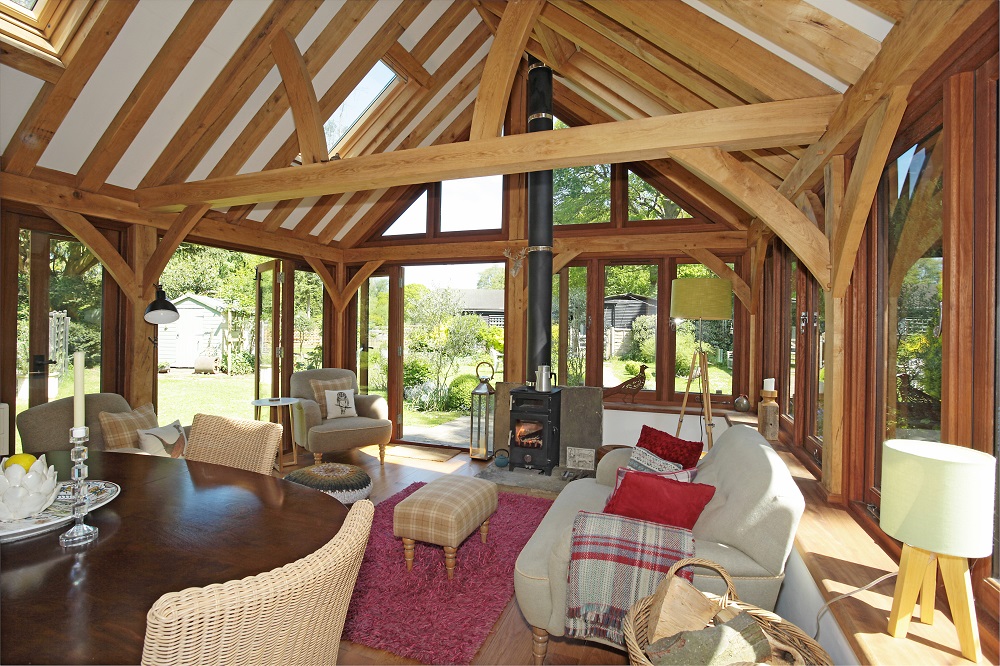
An oak-framed garden room can become an integral part of a home, combining large areas of glazing with the warmth and character of exposed timber. Glazing will require cleaning, gutters need to remain clear, and timber joinery may need periodic treatment. Roofing and the wider building envelope should also receive the same routine attention as other parts of the home.
When a garden room is built as an extension and connected directly to an existing property, maintenance needs to be considered across the whole structure. As the internal space will be seamlessly connected to the rest of the home, this is easily taken into account when cleaning elsewhere.
The structural frame itself, however, requires very little ongoing maintenance. This can make oak particularly attractive for homeowners who want to create a distinctive everyday living space without introducing an unnecessarily demanding structural material.
Garages and Oak-Framed Buildings with Rooms Above
The same principles as above will apply to garages, though more sweeping may be required if the garage bays are open because leaves and other debris have more opportunities to enter.
A larger oak-framed building with a room above will naturally contain more elements to consider. Depending on its design and intended purpose, an upper floor might provide valuable additional space for an office, hobby room, or another suitable use. Windows, doors, staircases, roofing, and other components each introduce their own maintenance requirements, but this additional complexity doesn’t fundamentally alter the maintenance requirements of the structural oak frame.
This is one reason bespoke design matters. Rather than starting with a generic structure and trying to adapt it later, the building can be developed around the space and functionality required from the outset.
Leisure Buildings and Pool Enclosures

Leisure buildings present an interesting example because their internal environments can differ significantly from conventional garages and outbuildings. An indoor swimming pool, for instance, creates substantial humidity and moisture considerations. The entire building, therefore, needs to be appropriately designed for its intended environment. This includes its ventilation, insulation, glazing, and other components.
This is an important reminder that choosing a durable structural material is only one part of creating a long-lasting building. Good design must consider how the finished space will actually be used.
The flexibility of bespoke oak framing allows a leisure building to be developed around these requirements while creating an attractive space where the structure itself can become an important architectural feature.
Commercial Oak-Framed Buildings
Oak isn’t limited to homes and gardens. Oak-framed buildings can also provide distinctive spaces for commercial settings, where appearance may be almost as important as practicality.
Commercial buildings can experience greater footfall and more intensive everyday use, meaning components such as doors, flooring, glazing, and other finishes may need more frequent attention. The fundamental maintenance characteristics of the oak structural frame, however, remain much the same.
For businesses seeking a building that makes an immediate visual impression while drawing on traditional English architecture, oak offers something very different from a conventional steel or masonry structure.
Does Oak Need Treating to Last?
A common assumption is that any timber used outdoors must be regularly treated to prevent deterioration. With an appropriately designed oak structural frame, this isn’t the case. For example, our own oak frames do not require routine treatment. Wooden joinery used elsewhere within a building may need to be treated, while ordinary tasks such as keeping gutters clear and maintaining windows will still be necessary.
Owners should also expect the appearance of oak to evolve. Natural changes in colour, minor movement, and the character that develops as green oak matures should not automatically be confused with structural deterioration. These qualities are part of what gives traditional British oak-framed buildings their unmistakable appearance and have helped make timber framing an enduring feature of the UK’s architectural heritage.
What Does “Low Maintenance” Really Mean Over the Lifetime of a Building?
When investing in a substantial new building, maintenance is best considered over decades rather than months. Instead of looking for a material that requires absolutely no attention, it is more useful to ask what will need maintaining, how often it is likely to require attention, and what that maintenance is designed to protect.
Brick, steel, and oak are all capable of creating durable structures when they are correctly designed, manufactured, and constructed. Oak offers a particularly compelling combination of qualities. It is strong and durable, requires very little structural-frame maintenance, and possesses a natural appearance that can become richer in character as the material matures. It also offers excellent design flexibility.
The same fundamental framing principles can be used for everything from an intimate garden room to a substantial garage, leisure complex, or commercial building. This means the choice of oak doesn’t have to dictate what your building becomes; instead, the frame can be developed around what you need the space to achieve.
Bespoke Oak-Framed Buildings Designed for Generations/

The long-term success of an oak building depends on far more than simply selecting oak as a material. Design, timber grading, manufacturing accuracy, and craftsmanship all matter. We have specialised in the manufacture of bespoke oak-framed buildings for over 30 years, combining traditional English jointing techniques with modern precision engineering at our Sussex workshop.
Every frame is made to order, allowing the design to reflect the property, available space, and intended purpose. All our oak is carefully graded throughout production before precision manufacturing technology is used to translate the approved 3D design into accurately cut frame components. Traditional jointing methods then allow the finished sections to fit together in the time-honoured way.
This approach has helped us manufacture more than 10,000 buildings across the UK, and our BM TRADA Q-Mark certification provides further independent reassurance of our commitment to quality. Meanwhile, structural frames assembled by an approved contractor are backed by a comprehensive 10-year frame guarantee.
Create an Oak-Framed Building Made to Last
Choosing a building is about creating something you can continue to use, enjoy, and take pride in for decades to come, not just to admire on the day it’s completed. A carefully designed oak frame offers the chance to combine practicality with genuine architectural character, creating a building that can mature naturally rather than simply grow older.
Whether you are considering a garden room, garage, leisure space, commercial project, or an entirely bespoke concept, English Heritage Buildings can help you explore what is possible.
Discover our oak-framed building designs, speak to our experienced team about creating something bespoke, or arrange a visit to our Sussex workshop. You’ll see how traditional craftsmanship and precision manufacturing come together to create oak-framed buildings designed for the future.
