Groundwork Options
Groundworks might not be the most exciting part of planning your new oak-framed building, but they are certainly one of the most important. The foundations and floor create the base that everything else is built on, so getting this right is essential for long-term strength and performance.
Different land and building uses call for different solutions. Making the right decisions starts with understanding the different types of foundations and which ones are most suitable for your site, so keep reading to explore your options.
A Note on Your Groundwork Options
While it might appear confusing at first, with English Heritage Buildings, you’ll never need to make these decisions alone. Our expert team will be on hand to help from the very beginning, working with you, your groundworker, and your local Building Control Officer where required to ensure everything is structurally sound and correctly specified.
What Do We Mean by Groundworks and Foundations?
Groundworks refer to everything that happens below floor level to prepare your site for a solid, stable build. This includes digging, levelling, drainage, and putting in the foundations.
Foundations are what anchor your oak building to the ground. They help spread the load of the frame evenly and ensure the structure stays secure over time, even as the soil beneath moves or settles slightly. Getting them right is important because it will help to avoid costly problems later down the line.
The type of groundwork and foundation needed will depend on:
- The condition of the soil on your site
- The size and shape of your building
- Whether the floor will be insulated or uninsulated
- How the oak frame is being fixed into place
Foundation Options
Foundation types are typically divided into two categories: shallow foundations and deep foundations.
We’ve outlined the main foundation types for both below, along with when each type is usually recommended.
Shallow Foundations
These foundations are used when the load of the structure can be supported close to the surface. There are three main types:
Pad Foundations
Pad foundations are square or rectangular holes filled with concrete, used to support individual posts or columns. Each pad supports a single point, and staddle stones are often placed on top for the oak post to sit on.
We supply two types of staddle stones:
- Tapered stones: Used in open areas or where the post is visible.
- Flat stones: Used against existing buildings or where garage doors are fitted.
These staddle stones are made from reconstituted stone for durability. Natural sandstone is not recommended, as it tends to absorb moisture, causing it to break down when the stones freeze.
Best for: Smaller buildings, posts set apart, or where minimal ground disturbance is needed.

Strip Foundations
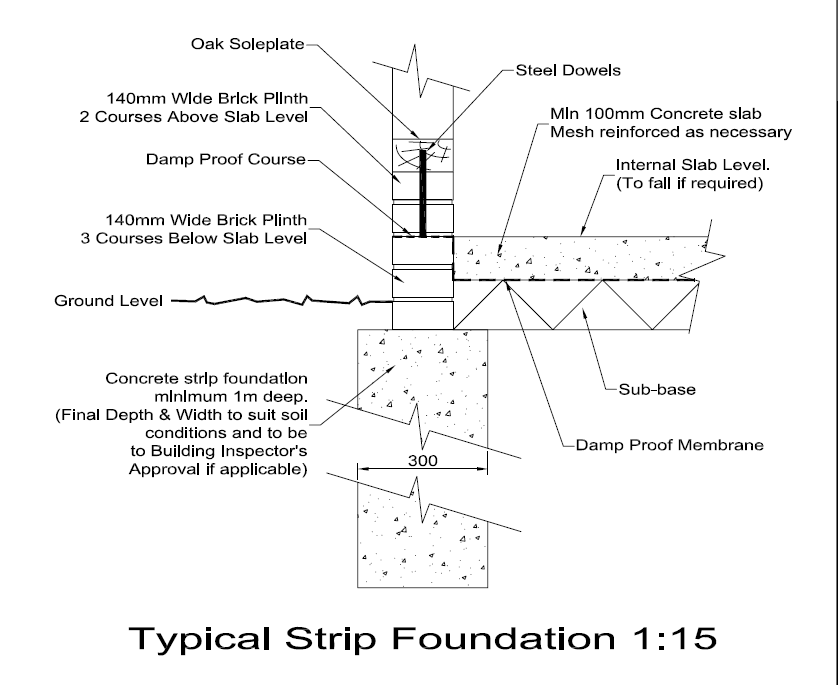
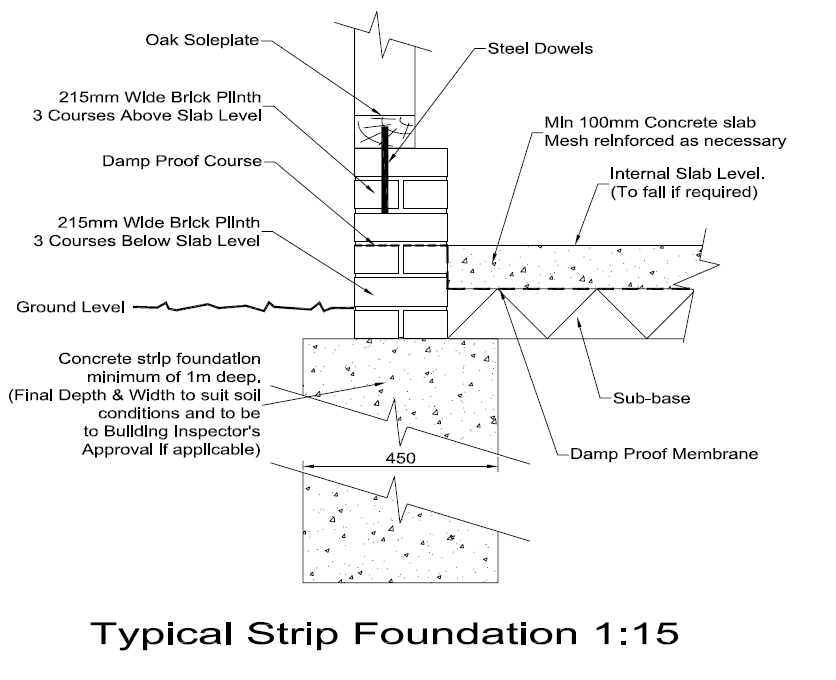
Strip foundations are continuous trenches filled with concrete, designed to support a wall rather than a single point. There should be a minimum of 75mm of footing showing on each side of the wall that sits on it. This is the most common type used in oak-framed buildings, and provides a reliable base for load-bearing walls.
The width and depth of the trench will depend on your soil type and wall construction. Your local Building Control Officer will advise on what’s suitable for your site.
Best for: Most oak frame buildings with perimeter walls, including garages and garden rooms.
Raft Foundations
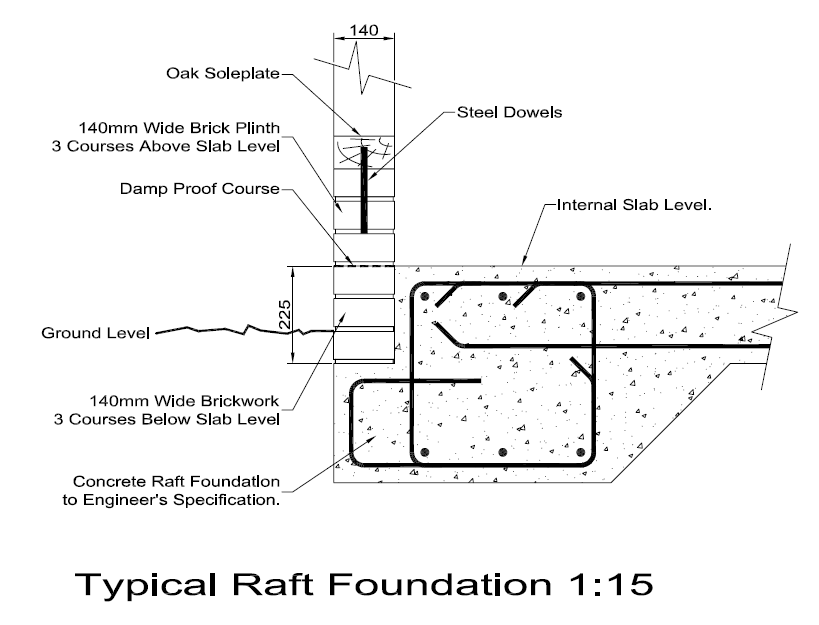
A raft foundation is a large, flat slab of reinforced concrete that spreads the load of the entire building across a wide area. This is typically used on softer or less stable soils with low bearing capacity.
Raft foundations must be designed by a structural engineer, based on ground conditions and the size of the building.
Best for: Sites with poor or loose soil, or where a uniform load distribution is needed.
Deep Foundations
If the soil near the surface can’t support the load of the building, or if the ground varies significantly across the site, deep foundations may be required. These transfer the load down to more stable layers further underground, usually over 3m deep.
An example of this is a Piled foundation.
Piled Foundations
Piled foundations use long, slender concrete or steel columns driven deep into the ground. These piles reach down to stronger soil or rock layers that can support the structure.
Installing this type of foundation requires a specialist contractor and is usually only needed in more complex builds or where the soil is particularly poor.
Best for: Sites with weak surface soils, high water tables, or uneven ground conditions.#
When Are Deep Foundations Required?
While most projects won’t require them, deep foundations may be necessary if:
- Your site has soft or compressible soil
- There are large changes in ground level or a steep slope
- The building is particularly large or heavy
- Local conditions raise concerns during ground investigation
We’ll always discuss foundation options early in the design process, so there’s time to plan the best solution with your chosen contractor.
Supporting the Frame: Insulated Walls
Once the foundations and floor are in place, the next step is to consider the walls and flooring. If the ground floor of your building will be insulated, then you have the choice of putting the oak soleplate at finished floor level (FFL) or having a dwarf wall for the frame to sit on.
Both methods are fully compatible with our oak frames. We’ll recommend the right approach based on your building’s layout, insulation needs, and the look you want to achieve.
Soleplate at Finished Floor Level (FFL)
This is the method we recommend for most buildings, especially those with a larger span. It allows the oak frame to be securely fixed to the floor for added strength.
The concrete base (known as the oversite) is poured first, and then a short plinth wall is built on top. This wall is raised just enough to allow for insulation and a screed layer, usually around 150mm in total, so that the finished floor ends up level with the bottom of the oak frame.
Dwarf Wall

A dwarf wall is a low cavity wall that the oak frame sits on, often used in garden rooms or similar spaces where you may want a different finish at ground level. Instead of resting directly on the floor, the frame is fixed to a horizontal timber beam (called a soleplate) that runs along the top of the outer brickwork.
This soleplate is made from Douglas-fir, which is more stable than oak and helps prevent shrinkage that could affect internal features like window boards. This soleplate sits on the outside brick skin, which distributes the weight of the building along the whole wall. The wall itself is built with thicker-than-average blockwork, and, depending on the height of the wall, the block size may vary.
We carefully consider the suitability of any foundations and plinth walls our frames sit on before proceeding.
Oversite and Floor Options
The oversite is the internal ground floor of your building, the solid base that sits inside the foundations. How this part of your building is constructed will depend on whether the floor needs to be insulated.
This is all planned early in the design process to ensure your building meets structural, thermal, and usability requirements. If you’re planning to heat or insulate the space, or use it year-round, this part of the build plays a key role in long-term comfort and energy efficiency.
Uninsulated Floor
This type of floor is typically used for garages, open-fronted buildings, and outbuildings that won’t be heated or used as living space. It includes:
- A compacted sub-base
- Sand blinding
- Damp-proof membrane
- Reinforced concrete slab
We normally recommend adding a gentle slope (about 25mm) on open-fronted structures so that rainwater naturally runs out rather than pooling inside.
Insulated Floor
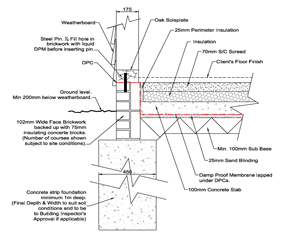
This type of floor is typically used for garden rooms, offices, and any oak frame building where warmth and comfort matter. In addition to the standard base, you’ll also want to consider:
- A layer of insulation on top of the concrete
- A sand and cement screed over the insulation
- Optional underfloor heating built into the screed
- Your final floor covering (such as tiles, timber, carpet)
The thickness of insulation will depend on the U-value (thermal performance) you need.
Mixed-Use Buildings
If only part of the building is being insulated (for example, an office next to an unheated garage), the floor levels will need to differ slightly to meet Building Regulations.
The simplest way to manage this is to keep the main concrete base the same across the whole building, and then build up the insulated areas with a layer of insulation and screed. This usually creates a height difference of around 100mm between the insulated and uninsulated sections, as required by regulations.
To keep everything consistent, we use a 150mm high plinth wall throughout, so that the oak frame sits at the same level across the entire structure. This makes the installation clean, accurate, and easier to finish, with no need for adjustments or compromises later.
It’s Always Best to Get Site-Specific Advice
In addition to the foundation types mentioned, there are other types like pad and beam and beam and block, both of which have their uses in specific conditions.
No two building sites are exactly the same, and we always advise involving your groundworker and Building Control Officer early in the process to help guide your decision. Together, we can make sure that your groundworks are properly specified, approved, and ready for your oak frame to be installed without delay.
We will always take the time to consider how your frame connects to the ground and how the entire structure performs as a whole. It’s this attention to detail that helps prevent costly surprises later, and ensures your building is as sound as it is beautiful.
Speak to Us About Your Dream Project
The information on this page explains the most common groundwork and foundation options in more detail. If you’re not sure what’s right for your site, we’re always happy to help.
Get in touch today to discuss your project, and we’ll guide you through the options that best suit your plans, your setting, and your budget. You can also request a tailored, no-obligation quotation or book a visit to our Sussex-based workshop to get a feel for our oak buildings up close.
